Red States, Blue States, Purple States, and the 2026 Health Freedom Index
We ran three simple analyses to inspect how the conventional red-blue-purple state designations relate to health freedom as measured by our 2026 Health Freedom Index.

View/Download [PDF]
Rhoads, J. "Red States, Blue States, Purple States, and the 2026 Health Freedom Index" Center for Modern Health. November 2026.
The 2026 Health Freedom Index, published by the Center for Modern Health in partnership with the Knee Regulatory Research Center, evaluates health policy across all 50 states and the District of Columbia. It examines 54 policy variables across five categories: Professional Freedom, Institutional Freedom, Patient Freedom, Payment Freedom, and Delivery Freedom. Together, these categories assess how much freedom patients, healthcare professionals, insurers, and healthcare organizations have to make voluntary healthcare decisions. The Index provides a set of scores and rankings that can be used not only to compare states, but also as a starting point for further research and analysis. One of our hopes is that other researchers and policy organizations will produce spinoff or derivative articles that use the Index to run new analyses and examine the data through different lenses.
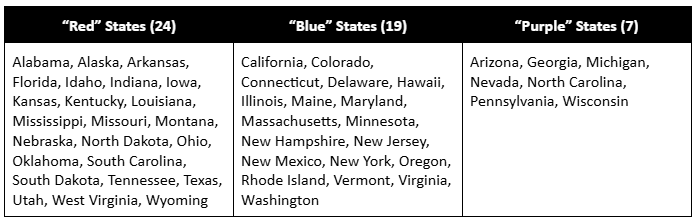
This article is an example of one such exercise. We look at the familiar red-state, blue-state, and purple-state divide in American politics and ask whether these categories correspond to differences in health freedom scores. We use the state color designation published by The Cook Political Report, a widely recognized source for assessments of the American political landscape (see Table 1). State color designations are crude generalizations but they can be helpful in understanding the interplays of politics and policy at the state level.
Analysis A. Do red, blue, and purple states differ in overall health freedom?
For this analysis we calculated the mean overall HFI score for each group, as well as the median, range, and number of states in each group. This analysis tests the common assumption about American politics that red states are more favorable to free markets and freedom, while blue states tend to favor greater government involvement. By comparing HFI scores across red, blue, and purple states, we can see whether that political stereotype holds up in health policy, or whether things are more complex than commonly presented.
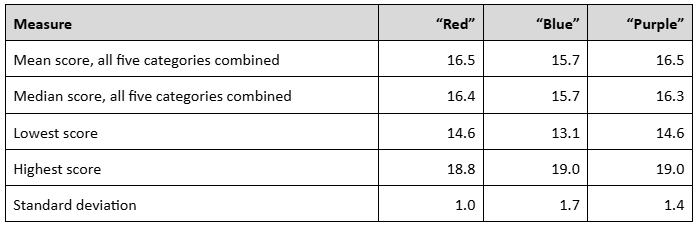
The results of this simple analysis show that red and purple states are very similar in their HFI scores, and blue states are only slightly lower. Using Welch's ANOVA as a test of whether at least one of the three group means differs significantly from the other two yields a p-value of 0.20. In other words, the group means do not differ significantly.
Other things we can glean include that blue states and purple states vary more than red states. Also, the blue state group has a wider range than the red and purple state groups. One could say that the blue state group includes the "worst of the worst" while also having the "best of the best," or at least being tied for it. (The best purple state is Arizona, ranked 1st overall in the index, while the best blue state is Colorado, ranked 2nd overall.)
Analysis B. How do red, blue, and purple states vary across categories of health freedom?
For this analysis we calculated each group's average score separately for each of the five policy categories in the Health Freedom Index: Professional Freedom, Institutional Freedom, Patient Freedom, Payment Freedom, and Delivery Freedom. This analysis lets us test conventional beliefs, for instance whether blue states allow more freedom in the Patient Freedom category (i.e., think bodily autonomy), whereas red states allow more freedom in the institutional or payment categories (i.e., think economic freedom and free markets). We can also look at which areas the purple states land in between the red and the blue states, versus being above or below.
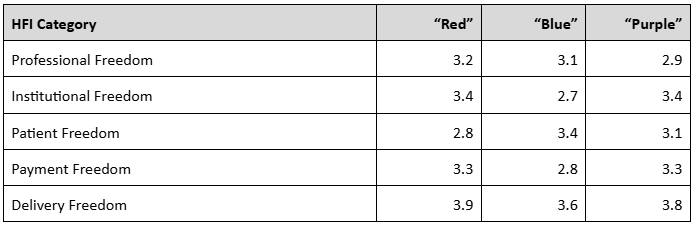
The results of this analysis show that, in aggregate, red states were better than the other state groups in two categories (Professional Freedom and Delivery Freedom), and worse than the other state groups in one category (Patient Freedom). Blue states were better than the other state groups in one category (Patient Freedom), and worse than the other state groups in three categories (Institutional Freedom, Payment Freedom, and Delivery Freedom).
As for where purple states land in relation to red and blue states, in only two of the five categories did purple states land in between red and blue states. In one area (Professional Freedom) purple states were worse than both red and blue states. In two areas, purple states were as good as the best red or blue state group (Institutional Freedom and Payment Freedom).
Analysis C. How do red, blue, and purple states vary on individual policies?
For this analysis we calculated each variable's score across red, blue, and purple states. For readability, we report the results one category at a time (e.g., Professional Freedom, Institutional Freedom, and so on). See the series of tables below. After each table, we comment briefly on the findings for that category.
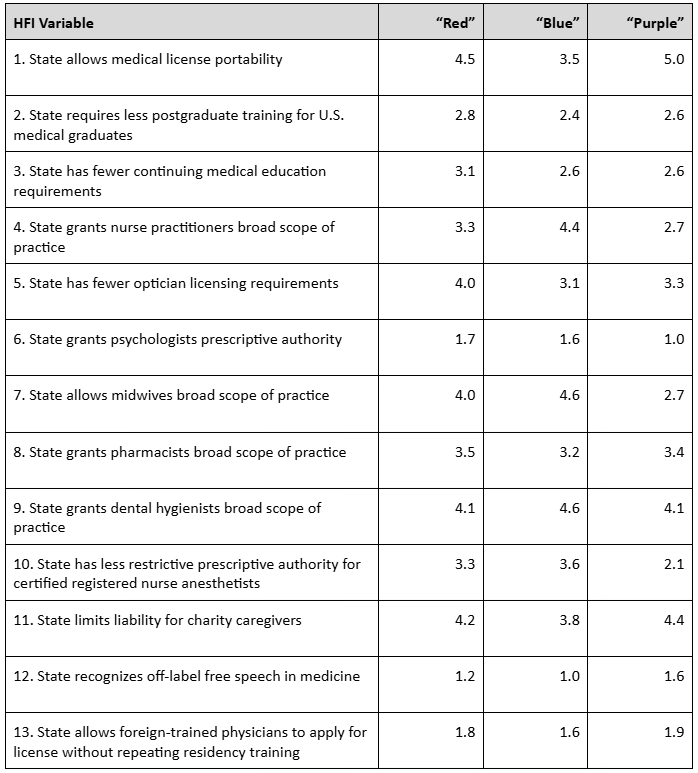
For most variables in the category of Professional Freedom, the variation in score between the three state color designations is relatively little. Red states were the freest in 5 variables; blue states were the freest in 4 variables; purple states were the freest in 4 variables. None was particularly dominant in this category.
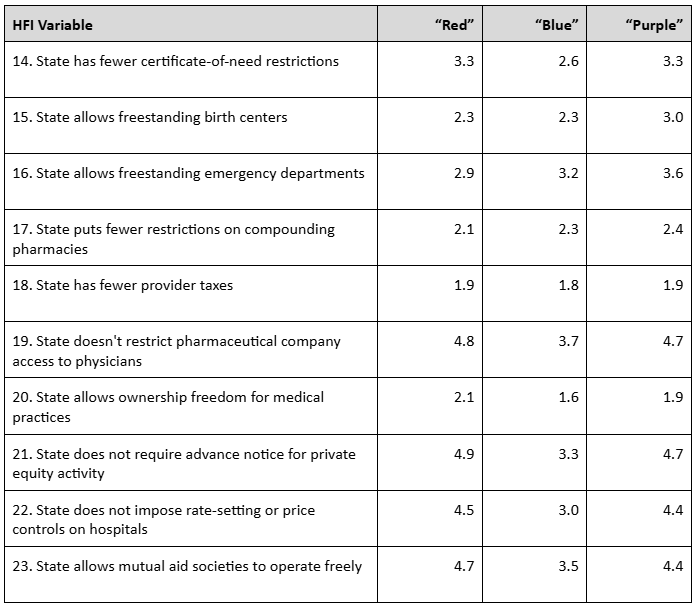
In the category of Institutional Freedom, red and purple states were noticeably more free than blue states. Allowing for double counting due to ties, red states were the freest in 6 variables; blue states were the freest in 0 variables; purple states were the freest in 5 variables. Blue states are more likely to restrict pharmaceutical company access to physicians than other states. They are also more likely to require advance notice for private equity activity, impose rate-setting or price controls on hospitals, and make it difficult for mutual aid societies to operate freely.
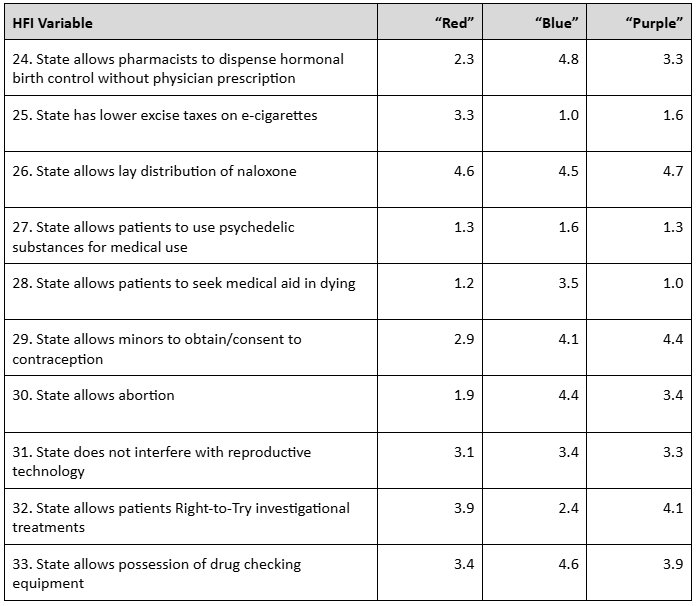
In the Patient Freedom category, blue states were noticeably more free than red or purple states. Red states were the freest in 1 variable; blue states were the freest in 6 variables; purple states were the freest in 3 variables. In several cases, the differences in freedom score between the most free color category of state and the other two categories was substantial. For instance, blue states are much more likely to allow pharmacists to dispense hormonal birth control without physician prescription than red or purple states. They are also much more likely to allow abortion and much more likely to allow possession of drug checking equipment. That said, red states in this category are much more likely to have lower excise taxes on e-cigarettes, and red and purple states together are much more likely to have strong Right-to-Try laws allowing individuals better access to investigational treatments.
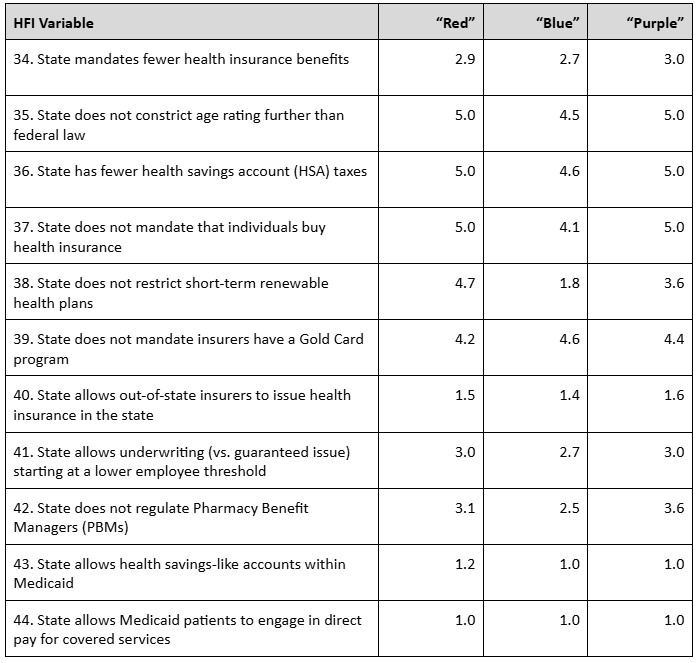
In the Payment Freedom category, red states and purple states tended to be freer than blue states. They scored higher than blue states on 8 of the 11 variables in this category. One variable that stands out in terms of this dynamic is variable #38, which captures whether a state restricts short-term renewable health plans. Blue states tend to restrict short-term renewable health plans, making them a less free environment for insurers and customers who would like to voluntarily enter into that kind of arrangement. The one variable in this category where blue states do better than red and purple states is variable #39, which measures whether states mandate that insurers have a Gold Card program. Blue states are less likely to mandate those programs, so they are more free in that regard.
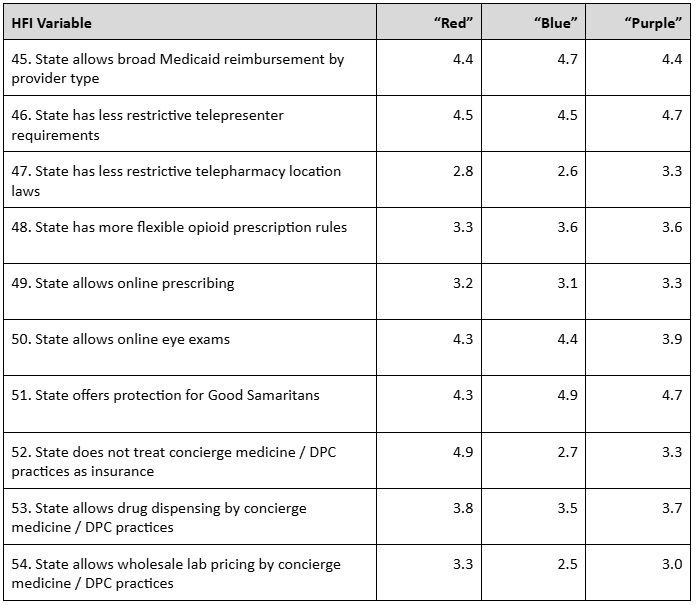
In the category of Delivery Freedom, the red-blue-purple tendencies were less strong than they were in other categories. Allowing for double counting due to ties, red states were the freest in 3 variables; blue states were the freest in 4 variables; purple states were the freest in 4 variables. One variable on which red states stand out in a positive way is in not treating concierge medicine and direct primary care practices as insurance. In other words, red and blue states have not done as good a job, on average, at clarifying that member-based subscription-type practices should be allowed to operate. Two variables in which blue states stand out in a positive way are in allowing a broad array of clinical providers to be reimbursed by their state’s Medicaid program, and in offering liability protections for Good Samaritans.
Conclusion
These three analyses suggest that the relationship between state political leanings and health freedom is more nuanced than the standard red-state/blue-state stereotypes might lead us to expect. There are some differences and patterns based on a state's "color." Red and purple states tend to score better on Institutional Freedom and Payment Freedom. Blue states tend to score better on Patient Freedom. None of these political color groups has a stronghold on health freedom. Each group has areas of relative strength and weakness. All could stand to improve.
Every analysis reported on here was conducted using the data in the 2026 Health Freedom Index downloadable spreadsheet, along with the state designations sourced from The Cook Report, as already described. We encourage other researchers and policy analysts to use the HFI data to test their own hypotheses and uncover patterns that can inform a more productive discussion about health policy and freedom. Finally, we also welcome readers to use the findings in this paper to write commentaries that explain or examine these patterns, propose advocacy strategies, or suggest ways to expand health freedom at the state level.
Photo courtesy of Bobbi from Pexels.