Additional Testimony on Vermont S 142 Regarding Foreign-Trained Physicians
Vermont can safely license foreign-trained physicians and expand its supply of physicians.
View/Download [PDF]
Rhoads, J. "Additional Testimony on Vermont S 142 Regarding Foreign-Trained Physicians" Center for Modern Health. February 2026.
Note: This is follow-up testimony provided to the Vermont Senate Health and Welfare Committee regarding Senate Bill 142. The bill would create a pathway for foreign-trained physicians to become licensed to practice medicine without being required to repeat their residency training. You can also view the text of the bill and read our prior testimony on this same bill.
Chair Lyons and Members of the Committee:
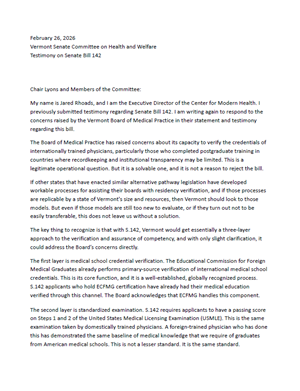
My name is Jared Rhoads, and I am the Executive Director of the Center for Modern Health. I previously submitted testimony regarding Senate Bill 142. I am writing again to respond to the concerns raised by the Vermont Board of Medical Practice in their statement and testimony regarding this bill.
The Board of Medical Practice has raised concerns about its capacity to verify the credentials of internationally trained physicians, particularly those who completed postgraduate training in countries where recordkeeping and institutional transparency may be limited. This is a legitimate operational question. But it is a solvable one, and it is not a reason to reject the bill.
If other states that have enacted similar alternative pathway legislation have developed workable processes for assisting their boards with residency verification, and if those processes are replicable by a state of Vermont's size and resources, then Vermont should look to those models. But even if those models are still too new to evaluate, or if they turn out not to be easily transferable, this does not leave us without a solution.
The key thing to recognize is that with S.142, Vermont would get essentially a three-layer approach to the verification and assurance of competency, and with only slight clarification, it could address the Board’s concerns directly.
The first layer is medical school credential verification. The Educational Commission for Foreign Medical Graduates already performs primary-source verification of international medical school credentials. This is its core function, and it is a well-established, globally recognized process. S.142 applicants who hold ECFMG certification have already had their medical education verified through this channel. The Board acknowledges that ECFMG handles this component.
The second layer is standardized examination. S.142 requires applicants to have a passing score on Steps 1 and 2 of the United States Medical Licensing Examination (USMLE). This is the same examination taken by domestically trained physicians. A foreign-trained physician who has done this has demonstrated the same baseline of medical knowledge that we require of graduates from American medical schools. This is not a lesser standard. It is the same standard.
The third layer is the supervised practice period. S.142 requires foreign-trained physicians to practice under supervision for a defined period before obtaining full licensure. This is a direct, real-world assessment of clinical competence. This is arguably a better test and verification of knowledge and skills than any paper-based residency quality check. A physician who performs well under the supervision of a licensed Vermont institution over two years of actual patient care has demonstrated his or her abilities in a way that no transcript or certificate can fully capture. Any doubt or question as to the ability of an applicant to practice medicine effectively in Vermont will be revealed by this feature of the bill.
Taken together, these three layers of competency checks provide robust, overlapping safeguards that protect patients without requiring the Board to independently investigate foreign residency programs, which seems to be the Board’s biggest concern with the bill.
Going this route, if the supervised practice period is to function as the practical substitute for verifying foreign residency training, perhaps a clarification could be made to S.142 to strengthen it and address the Board's verification concerns directly. The bill could make explicit that successful completion of the supervised practice period (combined with ECFMG certification and passage of Steps 1 and 2 of the USMLE) satisfies the state's requirements for verification of postgraduate clinical training. Among other things, that rightly puts the competency test where it belongs, which is as a final check at the end of the pathway, instead of as a barrier to entry at the beginning of the pathway.
In summary, other states comparable to Vermont have likely wrestled with this issue and found a solution. We may hear examples from other testifiers. However, even if no ready-made solution exists from a state comparable to Vermont in population and resources, S.142 could still proceed with the clarification described above.
Thank you for your time.
Jared Rhoads